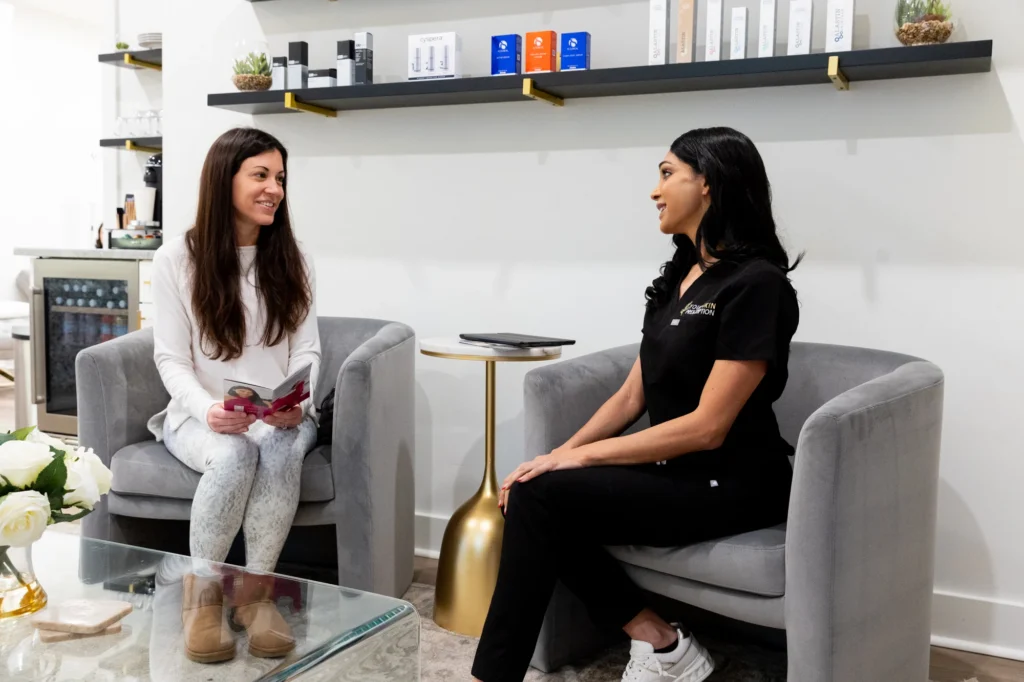
An o shot for women is a private medical visit, not a treatment you should book from a headline. The useful first step is a short list of questions about your goals, your health history, comfort, and follow-up. Your Skin Prescription offers the O-Shot in Sewickley as a platelet-rich plasma treatment planned with a provider, not as a guaranteed result. Before you write, read the O-Shot consultation information so your questions match the visit the practice actually offers.
Request a private O-Shot consultation in Sewickley
What an O Shot for Women Consultation Should Cover
A good consultation gives you room to talk before anyone discusses an injection. At Your Skin Prescription, women’s health visits start with a plan built around your history and your goals. That is the point of the appointment, not a formality before a procedure.
Bring the concern that made you search, and say it in plain language. Leakage with a cough, dryness that makes intimacy uncomfortable, or a change in sensation are different starting points. A provider cannot match a plan to a concern you have not named.
You should also hear what this visit will not decide. No one can promise orgasm, bladder control, or a timeline from a conversation alone. If a page or ad sounds certain, treat that as a reason to slow down and ask more questions.
Use the visit to learn who will see you. For the O-Shot, ask to meet a Physician Assistant or another trained medical provider. An aesthetician is the right clinician for a facial or microneedling. This treatment is medical, so the person across from you should be a medical provider.
Write your questions down. Privacy makes it easy to forget the one you cared about most. A short list keeps the hour focused on you.
Questions an O Shot for Women Should Answer About Goals
Start with the result you hope for. Then ask how the provider will judge whether the O-Shot fits that hope. Wanting to feel like yourself again is honest. It is also too broad to plan around. A tighter goal is easier to discuss and easier to decline if it is not realistic.
Try questions like these:
- Which of my symptoms is this visit meant to explore?
- What change would count as useful for me, and what change is unlikely?
- Is this concern better evaluated by my gynecologist or primary clinician first?
- If the O-Shot is not the right match, what other women’s health option might we discuss?
Separate comfort, bladder symptoms, and sexual sensation. They can overlap, and they are not the same goal. A plan aimed at leakage is not automatically a plan aimed at pleasure, and the reverse is also true.
Ask how the provider will talk about benefit without turning a possibility into a promise. Platelet-rich plasma for vulvovaginal concerns is still an evolving area of care. A 2023 systematic review looked at PRP injections for female sexual dysfunction and stress urinary incontinence. It found the published studies too varied to support a single, certain outcome. That is why a careful clinic talks about candidacy, not a guaranteed change. You can read the review on PubMed.
If urinary leakage is the main issue, say so early. Your Skin Prescription also offers urinary incontinence treatment in Sewickley, including the Emsella chair, which is a different kind of visit. Naming leakage up front lets the provider tell you whether a PRP discussion, a pelvic-floor device discussion, or a referral comes first.
Bring a sense of timing, too. Ask whether you are gathering information for a later season of life, or whether you want a plan you could start after this visit. Both are valid. The questions change if you are only comparing options.
Questions About Candidacy and Medical History
Candidacy is a medical judgment, not a quiz you can pass from a blog. On the Sewickley service page, the practice states that women 18 or older who are not pregnant may be eligible, and that many patients are over 35. That is a starting boundary. It is not a yes for every adult who walks in.
Ask the provider to review the history that could change the plan. Useful questions include:
- Does pregnancy, trying to conceive, or a recent birth change whether we should wait?
- Which medicines, blood thinners, or bleeding conditions should I list?
- Do pelvic pain, recurrent infection, or unexplained bleeding need another clinician first?
- How do you handle a history of gynecologic surgery or cancer care?
- Should I speak with my own physician before we schedule anything beyond this consult?
The practice recommends that you talk with your primary clinician and review medicines before treatment. Ask what to bring so that conversation is useful: a medicine list, recent lab work if you have it, and the name of your gynecologist. You do not need a perfect file. You do need an honest one.
Ask who is not a candidate even when age and pregnancy status look fine. Active infection, unexplained bleeding, or a symptom that has never been examined are reasons to pause. A provider who welcomes that pause is protecting you.
Hormone changes belong in the same conversation, without turning the visit into a hormone sales pitch. If dryness or comfort shifted around menopause, say that plainly and ask whether another evaluation should come before PRP. Your Skin Prescription offers hormone replacement therapy in Pittsburgh as its own service. Ask whether that is relevant to your symptoms or whether it is a separate decision for another day.
Finally, ask how privacy works. A women’s health consult should feel discreet. Confirm who is in the room, what is written in your chart, and how follow-up messages are sent.
Questions About the Process, Comfort, and Cost
Once goals and history are on the table, ask what the visit itself involves. Keep these questions practical. You are deciding whether you understand the process, not memorizing a procedure.
Ask what is drawn, what is prepared, and where a provider may place PRP. Ask what numbing is used, how long you are in the room, and what you can do the same day. The Sewickley service page describes the injection as brief, with no planned downtime, and says most people return to normal activities afterward. Confirm that this matches your health, rather than assuming a general note fits you.
Comfort questions worth asking:
- What will I feel during numbing and during the injection?
- Can I bring someone, or would you rather I come alone?
- What is normal tenderness afterward, and what should make me call?
- Which activities, intercourse, baths, or exercise should I pause, and for how long?
Ask about side effects without expecting a scare list or a shrug. The practice notes that side effects are not always present, and that you should contact your provider for extreme or worsening symptoms. Fever, severe swelling, bleeding, or signs of infection need urgent care. Put that threshold in your notes before you leave.
Cost belongs in the same conversation, after the medical fit is clear. Your Skin Prescription does not publish one O-Shot price, because the fee depends on your goals, your history, and the provider’s assessment. Ask for the current fee, what it includes, and whether a plan may involve more than one session before you agree to anything. The consult is the right place for that number. A blog is not.
If you want a broader look at women’s wellness visits in the area, read the practice’s sexual wellness consultation overview after this page. Use it to see how O-Shot and Emsella differ. Then bring the difference back as a question, not as a decision you already made online.
Questions to Ask About Follow-Up
A consult is incomplete if it ends when you stand up. Ask what happens next if you proceed, and what happens if you do not.
The service page lists a general range of 3 to 6 sessions and says the duration of results varies. Treat both as topics to confirm, not as your personal plan. Ask why someone might stop at one visit, why another person might be asked to return, and how the provider decides. A fixed package sold before your history is reviewed is a weak answer.
Follow-up questions to keep on your list:
- When should I expect a check-in, and is it in person or by message?
- What change is reasonable to notice, and what non-change is also normal?
- Who do I contact if symptoms worsen, including after hours?
- How will we decide whether another session makes sense?
- What would make you recommend I see a gynecologist or urogynecologist instead?
Ask how the practice handles a result that is smaller than you hoped. A trustworthy answer leaves room for “this did not help enough” and for a referral. Platelet-rich plasma is your own blood product, which is why clinics describe it as a natural option. That fact does not make a benefit automatic. That is why you should be skeptical of marketing that promises dramatic results and ask what the evidence can and cannot show before you compare clinics.
If you are comparing visits over time, ask how ongoing care works at the practice. Med spa memberships in Pittsburgh cover repeat aesthetic care for clients who want a standing relationship with the team. Ask whether a membership has any bearing on women’s health follow-up, or whether O-Shot visits are planned one consult at a time. Those are different commitments.
For a treatment overview rather than a question list, the practice already explains the therapy in its O-Shot Pittsburgh women’s wellness guide. Read that when you want the broader picture. Use this article to decide what you will ask in the room.
How to Prepare for the Conversation
Preparation is short if your questions are already written. Plan on a private hour, not a drop-in between errands. You will talk about symptoms that are easy to rush past when you feel hurried.
Use this prep list:
- Write one primary goal and one concern you are willing to hear is a poor fit.
- List medicines, supplements, and any bleeding or clotting history.
- Note pregnancy plans, recent infections, pelvic pain, and surgeries.
- Bring prior instructions from your gynecologist or primary clinician.
- Decide what you need to hear about fee, comfort, and follow-up before you schedule treatment.
Wear something comfortable and arrive a few minutes early so you are not making medical decisions while flustered. Ask where to park and how discreet the check-in is if privacy matters to you that day. Your Skin Prescription is a Sewickley med spa serving Greater Pittsburgh, built as a calm, private room rather than a crowded clinic floor. Founder Rain Hoffmann spent years in healthcare before she opened the practice, and the women’s health visits are still planned with a medical provider.
You can compare the tone of the practice on the medical spa in Sewickley page, then come back to the questions that belong only to this treatment. A polished room does not replace a clear medical conversation. It should make that conversation easier to have.
Questions Worth Bringing to Sewickley
The table below is a pocket list, not a script the provider must follow. Cross off anything you already understand. Add the symptom that is actually yours.
| Topic | What to learn | A useful way to ask |
|---|---|---|
| Primary goal. | Whether the visit is about comfort, leakage, sensation, or more than one issue. | Which of these symptoms is realistic to discuss for the O-Shot? |
| Medical history. | Whether pregnancy, medicines, infection, pain, or prior surgery should change the plan. | What in my history would make you delay or refer me? |
| Who provides care. | A Physician Assistant or trained medical provider should lead the visit. | Who will consult with me, and who would perform treatment? |
| Comfort and the visit. | Ask about numbing, time in the room, same-day activity, and warning signs. | What should I feel, and what should make me call the office? |
| Sessions and follow-up. | Ask why a plan might be one visit or several, and how results are judged. | How will we decide whether I need another session? |
| Fee. | Ask for the current fee and what it includes, quoted for your plan. | What is the fee for the plan you would actually recommend? |
| Other options. | Ask when Emsella, incontinence care, or a gynecology referral fits better. | What would you suggest if the O-Shot is not my best next step? |
Leave the consult able to restate three things in your own words. You should know the goal you named, the reason the provider thinks you are or are not a candidate, and the fee and follow-up that would apply if you continue. If any of the three is fuzzy, you are not behind. You just are not ready to book treatment, and that is a fair outcome of a first visit.
Your Skin Prescription will still be here when the questions are answered. The O-Shot is one women’s health option in a broader practice that also includes incontinence care and other wellness services. Choosing it, delaying it, or deciding it is not yours should feel like a decision you made with a provider, not a decision a webpage made for you.
Request your O-Shot consultation at the Sewickley office
Frequently Asked Questions
What should women ask before an O-Shot consultation?
Ask about your goal, your medical history, who will see you, what the visit feels like, how follow-up works, and what the current fee includes. Write the list down so privacy and nerves do not push the important question out of the room.
Is the O-Shot a guaranteed fix for sexual function or leakage?
No. Published PRP research for female sexual dysfunction and stress urinary incontinence is mixed and not uniform enough to promise a result. A consultation is where a provider tells you whether your goal is even a reasonable thing to discuss.
Who should perform an O-Shot consultation?
Ask for a Physician Assistant or another trained medical provider. At Your Skin Prescription, medical professionals handle medical treatments. A medical aesthetician is the right person for facials and microneedling, not for this visit.
Do I need my own doctor involved?
The practice recommends speaking with your primary clinician and reviewing medicines before treatment. Bring pelvic pain, bleeding, infection, pregnancy plans, or recent surgery to the consult so the provider can pause or refer when that is safer.
How many sessions should I expect?
The Sewickley service page lists a general range of 3 to 6 sessions and says results vary. Ask how that range applies to you. Do not accept a package count before your history has been reviewed.